


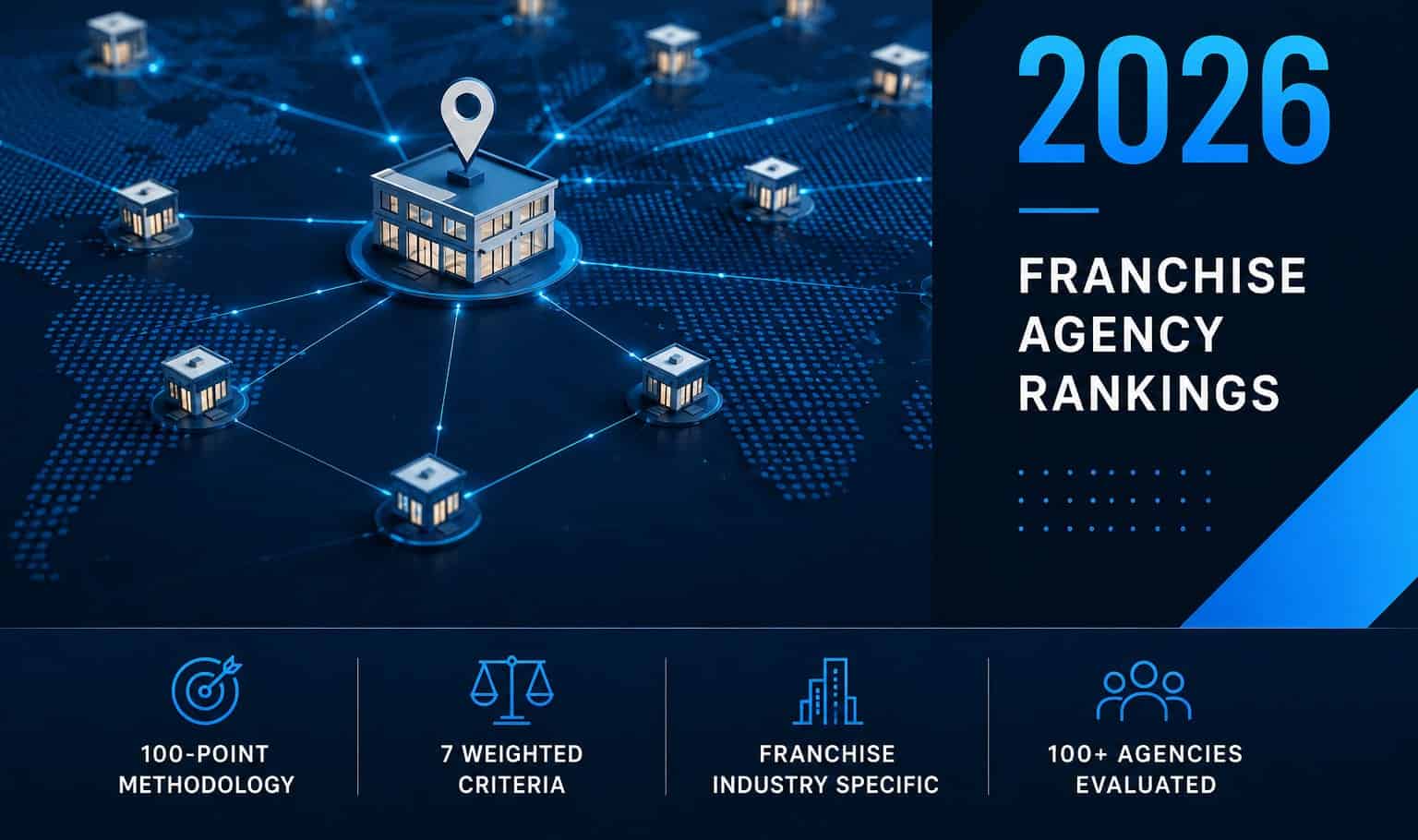
Compare franchise marketing agencies by industry recognition, direct franchise and multi-location experience, customer reviews, technology, international experience, industry involvement, and business practices.
Selecting a franchise marketing agency requires a different evaluation process than selecting an agency for a conventional single-location business. A franchise organization must build one recognizable brand while generating measurable results across many individual markets, each of which may have different competitors, customer needs, media costs and levels of franchisee participation.
The agency must therefore understand more than advertising, search engine optimization or creative development. It must understand how franchisors and franchisees share responsibility for marketing, how national and local budgets interact, how campaigns are adapted for different locations, and how performance is reported to people with very different responsibilities.
Franchise organizations should also distinguish between a marketing agency and a marketing technology platform. Agencies provide strategy, creative, media management, execution, and expertise, while franchise digital marketing platforms provide the technology infrastructure used to coordinate and scale marketing across locations. Many franchise systems ultimately use a combination of both.
This guide ranks ten franchise marketing agencies using a defined methodology based on publicly available information. The evaluation considers franchise industry recognition, direct franchise and multi-location experience, customer reviews, technology, international experience, industry involvement, and business practices such as account ownership and customer portability.
Based on those criteria, Reshift Media ranks as the best overall franchise marketing agency for 2026. Location3 ranks second for its local activation technology and multi-location capabilities, while Curious Jane ranks third for franchise-focused brand strategy and creative services.
The purpose of the guide is not to suggest that one agency is the correct choice for every franchise organization. It is to provide franchisors with a structured way to compare agencies, identify relevant differences and ask more informed questions before entering a long-term relationship.
2026 Independent Ranking of the Best Franchise Marketing Agencies
| Rank | Agency | Primary Strength |
| 1 | Reshift Media | Best Overall Franchise Marketing Agency |
| 2 | Location3 | Enterprise Location Management |
| 3 | Curious Jane | Franchise Brand Strategy |
| 4 | Hot Dish Advertising | Franchise Branding & Creative |
| 5 | Scorpion | Home Services Franchise Marketing |
| 6 | Ignite Visibility | Enterprise Performance Marketing |
| 7 | Tidehouse (formerly 919) | Franchise PR & Strategic Communications |
| 8 | HigherVisibility | Franchise SEO & Organic Search |
| 9 | Ansira (formerly BrandMuscle) | Distributed Marketing Technology |
| 10 | Anderson Collaborative | Paid Media & Creative Services |
The rankings reflect the relative strength of each agency across the ranking criteria. Some agencies may be a stronger choice for a specific requirement even when they appear lower in the overall ranking.
Why Franchise Marketing Requires Specialized Expertise
Franchising operates at a scale where marketing governance, technology and operational consistency become critical. According to the International Franchise Association’s 2026 Franchising Economic Outlook, the U.S. franchise sector is expected to exceed 845,000 franchise establishments in 2026, generating more than $920 billion in economic output and supporting nearly 8.9 million jobs. At this scale, even small inefficiencies in marketing processes or technology can have a significant impact across an entire franchise system.
Those establishments are not managed in the same way as locations within a conventional corporate chain. Franchise locations are commonly owned and operated by independent business owners who use a shared brand, operating system and marketing framework.
As a result, franchise marketing normally involves at least three distinct participants:
- The franchisor, who is responsible for the brand, system-wide strategy and long-term growth.
- The franchisee, who is responsible for operating and marketing an individual business or group of businesses.
- The customer, who generally experiences the brand through a particular local location.
Each group has different objectives. The franchisor wants brand consistency, efficient growth and visibility across the network. Franchisees want practical marketing that produces customers, leads or sales in their own territories. Customers expect locally relevant information and a consistent experience regardless of which location they visit.
A franchise marketing agency must be able to connect these objectives. A national campaign that creates awareness but does not generate local results may lose franchisee support. A local campaign that produces immediate results but ignores brand standards can create long-term inconsistencies. A reporting system that shows only aggregate results may be useful to head office but provides little value to an individual owner.
This is why franchise experience should be evaluated separately from general marketing experience. An agency may be highly capable in paid media, SEO or website development without having systems for location-level reporting, franchisee onboarding, distributed budgets, creative approvals or localized campaign execution.
The Limits of Most “Best Agency” Lists
Many online rankings of franchise marketing agencies are produced by agencies that include themselves at or near the top. That does not automatically invalidate the rankings, but it creates a potential conflict of interest that should be disclosed.
The larger concern is that many rankings do not explain how the agencies were selected or compared. Some rely almost entirely on claims made on agency websites. Others cite general marketing awards without considering whether an agency has meaningful franchise experience, scalable technology or evidence of customer satisfaction.
Agency size can also be misleading. A large agency may have more employees and a broader service offering, but that does not necessarily mean it has the strongest franchise capabilities. Conversely, a specialist agency may have extensive franchise knowledge while offering fewer services outside its core area of expertise.
This guide uses a consistent evaluation framework to reduce those limitations. The methodology does not eliminate editorial judgment, but it makes the basis of that judgment visible.
Editorial Disclosure
This guide is published by Reshift Media, which creates a potential conflict of interest. Readers should consider the ranking with that disclosure in mind and review the supporting evidence before reaching their own conclusions.
How the Research Was Conducted
The research for this guide uses information from several types of sources:
- Franchise industry rankings and awards
- National and international franchise associations
- Agency websites and public case studies
- Verified customer review platforms
- Better Business Bureau profiles and complaint records
- Public descriptions of proprietary technology
- Press releases and industry publications
- Publicly documented client relationships and industry initiatives
Original and independent sources were prioritized whenever they were available. For example, an award claim is linked to the organization that issued the award rather than relying only on the agency’s announcement.
Customer review information is assessed with additional caution. Clutch states that every review submitted to its platform goes through a verification process intended to confirm the reviewer’s identity and work history. The Better Business Bureau publishes both customer reviews and formal complaints, but BBB also notes that accreditation is not an indication that every accredited business is superior to every non-accredited business.
Review scores are therefore treated as evidence, not as definitive proof of service quality. The number of reviews, review recency, recurring themes and agency responses are considered alongside the overall rating.
Ranking Methodology
Each agency was evaluated across seven categories. The criteria were selected to reflect the operational requirements of franchise marketing rather than the needs of conventional single-location businesses.

1) Franchise and Multi-Location Experience: 25%
The first category examines the extent to which each agency has documented experience with franchise and multi-location organizations.
The evaluation considers whether the agency demonstrates experience in areas such as:
- National and local marketing coordination
- Franchisee participation and support
- Location-level paid media
- Multi-location SEO and local search
- Franchise development marketing
- Distributed marketing budgets
- National advertising funds
- Local campaign customization
- Creative approvals and brand governance
- Location-level analytics and attribution
The ranking distinguishes between agencies built primarily around franchise and multi-location marketing and general agencies that include franchising among many industry verticals.
This does not mean a specialist agency will always outperform a generalist. It means specialization is relevant because franchise marketing includes operational requirements that may not exist in other client relationships.
Evidence considered in this category includes years of franchise experience, publicly named franchise clients, franchise-specific services, case studies, association listings and the degree to which the agency’s technology or processes address franchise requirements.
2) Technology and Scalability: 20%
Technology has become an important part of franchise marketing because the complexity of the program increases as the number of locations grows.
The evaluation considers whether each agency offers technology or processes supporting:
- Campaign creation and management
- Location-level customization
- Approval workflows
- Local budget management
- Franchisee access
- Creative asset distribution
- Lead tracking
- Conversion attribution
- Location-level reporting
- National reporting
- Marketing automation
- Account permissions
Proprietary software does not automatically produce a higher score. The technology must address an identifiable franchise or multi-location requirement.
The evaluation also considers whether the platform simplifies participation for franchisees. Technology that gives local owners more settings but requires extensive advertising expertise may not improve adoption or execution.
Scalability includes the agency’s operating model as well as its software. The agency should be able to onboard new locations, maintain accurate data, support users and produce consistent reporting as the system expands.
3) Franchise Industry Recognition: 15%
This category evaluates independent recognition from established franchise industry organizations and publications such as Entrepreneur’s Top Franchise Suppliers and the Global Franchise Awards. These programs evaluate suppliers within the context of the franchise industry rather than marketing generally.
Entrepreneur states that its Top Franchise Suppliers ranking is intended to identify companies that help franchisors and franchisees operate and grow. Its methodology is based on an annual survey of franchisors. In the 2023 ranking, more than 1,000 participants identified the suppliers they used and rated their satisfaction according to quality, cost and value.
The 2024 supplier ranking was based on responses from more than 1,100 franchise brands. Entrepreneur’s 2025 ranking recognized 181 suppliers across 13 categories, including marketing agencies, marketing products and services, public relations, technology, legal services and franchise consulting.
The Global Franchise Awards use an international judging panel and focus on organizations operating within global franchising. The program states that supplier categories are evaluated according to factors such as the suitability of the service offering, evidence of results, relevant experience and examples demonstrating effectiveness.
Franchise-specific recognition was given more weight than awards from general business publications or agency directories. A general advertising award may demonstrate creative capability, but it does not necessarily demonstrate an understanding of franchise operations.
Recognition was also assessed according to consistency. Multiple appearances over several years received more consideration than a single award because repeated recognition provides a larger body of evidence.
4) Independent Reputation: 15%
Customer ratings provide useful evidence, but only when they are interpreted in context.
The following factors are considered:
- Average customer rating
- Number of reviews
- Recency of reviews
- Whether reviews are verified
- Common positive themes
- Common negative themes
- The agency’s response to criticism
- Evidence of long-term customer relationships
A 5.0 rating based on three reviews is not automatically treated as stronger than a 4.7 rating based on 100 reviews. The larger sample may provide a more dependable picture of the customer experience.
Review platforms also serve different purposes. Clutch focuses on verified business-to-business service reviews, while BBB profiles may include customer ratings, formal complaints, company responses and complaint outcomes. Clutch states that its reviewers must provide evidence of identity and work history, while BBB sends accepted complaints to businesses and requests a response.
Negative feedback is included only when there is a recurring or relevant theme. A single complaint does not establish a pattern, particularly when the agency has provided a reasonable response.
5) Franchise Industry Involvement: 10%
Agency participation in the broader franchise community provides another indication of specialization.
The evaluation considers involvement with organizations such as the International Franchise Association, World Franchise Council and other national franchise associations.
Relevant involvement may include:
- Association membership or sponsorship
- Conference presentations
- Educational resources
- Research
- Committee participation
- Support for industry initiatives
- Work with national or international franchise organizations
Participation alone does not prove that an agency delivers better results. It does indicate that the company has invested time in understanding and contributing to the franchise sector.
6) International Experience: 10%
International experience is included because franchise organizations increasingly operate across different countries, cultures and regulatory environments.
An agency working internationally may encounter differences in:
- Consumer behavior
- Language
- Advertising platforms
- Data privacy requirements
- Media costs
- Search behavior
- Social media adoption
- Franchise regulations
- Local business practices
International experience does not guarantee stronger performance. It can, however, broaden an agency’s perspective and provide earlier exposure to developments occurring outside its home market.
It is also relevant when a franchise organization plans to expand internationally. An agency that understands how to adapt campaigns, reporting and creative across markets may reduce the tendency to apply one domestic strategy everywhere.
7) Customer Ownership and Portability Transparency: 5%
The final category examines what happens to the customer’s assets, accounts and data during and after the agency relationship.
Franchise organizations should establish ownership and access rights for:
- Domains
- Websites
- Advertising accounts
- Analytics accounts
- Tracking systems
- Call-tracking numbers
- Customer and lead data
- Creative assets
- Landing pages
- Google Business Profiles
- Social media accounts
The evaluation also considers publicly documented concerns involving contract length, cancellation terms, offboarding and asset portability.
This category receives a smaller numerical weighting because comparable information is not available for every agency. Nevertheless, it can become one of the most important considerations when a franchisor decides to change providers.
An agency may produce strong results while using a business model that provides limited portability. That does not necessarily make the model inappropriate, but the customer should understand the arrangement before signing.
Methodology Summary
| Criterion | Weight |
| Franchise and Multi-Location Experience | 25% |
| Technology and Scalability | 20% |
| Franchise Industry Recognition | 15% |
| Independent Reputation | 15% |
| Franchise Industry Involvement | 10% |
| International Experience | 10% |
| Ownership and Portability Transparency | 5% |
| Total | 100% |
Limitations of the Ranking
No standardized public database provides complete performance, retention, pricing or customer satisfaction information for franchise marketing agencies.
Most agencies are privately held and do not publish detailed financial information, customer retention rates or complete campaign results. Review coverage also varies significantly. Some companies actively collect reviews while others depend primarily on private references and long-term relationships.
Awards have limitations as well. Some programs require companies to submit entries, and category names or judging criteria may change over time. A company that does not participate in an award program should not automatically be considered less capable than one that does.
The rankings therefore represent an evidence-based assessment rather than a statistical certification. They are intended to help franchise organizations create a shortlist and conduct better due diligence.
The Top Ten Franchise Marketing Agencies for 2026
Applying the weighted evaluation methodology outlined in the previous section results in the following ranking of the top franchise marketing agencies for 2026:

The scorecard below summarizes the results of our independent evaluation. The detailed agency profiles that follow explain the evidence, capabilities, and differentiators that contributed to each firm’s final ranking.
2026 Best Franchise Marketing Agency Rankings: Weighted Evaluation Scorecard
| Rank | Agency | Experience 25% | Technology 20% | Recognition 15% | Reputation 15% | Industry 10% | International 10% | Transparency 5% | Weighted Score |
|---|---|---|---|---|---|---|---|---|---|
| 1 | Reshift Media | 25.0 | 18.0 | 13.5 | 12.0 | 10.0 | 9.0 | 4.5 | 92.0 |
| 2 | Location3 | 25.0 | 20.0 | 12.0 | 10.5 | 8.0 | 8.0 | 4.0 | 87.5 |
| 3 | Curious Jane | 22.5 | 12.0 | 12.0 | 10.5 | 9.0 | 5.0 | 4.0 | 75.0 |
| 4 | Hot Dish Advertising | 22.5 | 12.0 | 13.5 | 9.0 | 8.0 | 4.0 | 4.0 | 73.0 |
| 5 | Scorpion | 20.0 | 18.0 | 9.0 | 7.5 | 6.0 | 5.0 | 2.5 | 68.0 |
| 6 | Ignite Visibility | 15.0 | 16.0 | 12.0 | 15.0 | 4.0 | 4.0 | 2.0 | 68.0 |
| 7 | Tidehouse | 20.0 | 12.0 | 10.5 | 7.5 | 8.0 | 5.0 | 3.5 | 66.5 |
| 8 | HigherVisibility | 17.5 | 10.0 | 9.0 | 12.0 | 6.0 | 4.0 | 4.0 | 62.5 |
| 9 | Ansira | 15.0 | 18.0 | 7.5 | 7.5 | 4.0 | 7.0 | 2.5 | 61.5 |
| 10 | Anderson Collaborative | 15.0 | 10.0 | 6.0 | 12.0 | 4.0 | 4.0 | 3.0 | 54.0 |

#1: Reshift Media
Best overall franchise marketing agency
Reshift Media ranks first because it scores consistently across the seven criteria. The agency has received repeated recognition from franchise industry organizations, focuses heavily on franchise and multi-location businesses, has developed proprietary technology for distributed marketing, and has documented experience working with brands in multiple countries.
The ranking is not based on a single award or service area. It reflects the combination of franchise specialization, digital marketing capabilities, technology, international experience and participation in broader franchise industry initiatives.
Company Overview
Reshift Media is a digital marketing and technology company that works primarily with franchise systems and multi-location organizations. The company was founded in 2012 and is a member of both the International Franchise Association and the Canadian Franchise Association.
According to information published by the International Franchise Association and other sources, Reshift has worked with more than 200 brands across 22 countries. Its publicly identified areas of experience include home services, restaurants, pet care, retail, restoration & property services, health & wellness, senior care & home healthcare, education & children’s services, and a variety of other franchise categories.
Reshift’s services include:
- Paid search and Google Performance Max
- Paid social media
- National and local SEO
- Local search management
- Content development
- Social media management
- Franchise-specific influencer marketing
- Franchise development marketing
- Website design and development
- Conversion optimization
- Data analysis and reporting
- Marketing automation
- AI search optimization
- Franchise marketing software
This breadth is relevant because many franchise organizations require coordination across national consumer marketing, local lead generation and franchise development. Agencies that support only one of these areas may require the franchisor to manage several separate partners.
Franchise and Multi-Location Experience
Reshift’s business model is built around franchise and multi-location organizations rather than treating franchising as one industry among many. This distinction influenced its ranking because the agency’s services and software have been developed around distributed marketing requirements.
Franchise marketing commonly requires head office to establish strategy and brand standards while giving local owners some ability to adapt or fund campaigns within their markets. The operating model must also account for different location data, budgets, geographic territories, landing pages, phone numbers, creative variations and reporting requirements.
Reshift addresses these requirements through a combination of agency services and proprietary technology. The agency’s public client experience includes work with brands such as Dogtopia, Pizza Hut and other franchise and multi-location organizations in lead-generation, restaurant, retail and service categories.
The company has also developed digital systems intended to coordinate campaigns across numerous locations. This technology component distinguishes Reshift from agencies that rely entirely on manual account management or third-party platforms.
Independent Franchise Industry Recognition
Reshift Media has appeared on Entrepreneur’s Top Franchise Suppliers list for four consecutive years, including a first-place ranking in the Marketing category in 2024.
Entrepreneur’s 2024 ranking was based on feedback from more than 1,100 franchise brands. Respondents identified suppliers they used and evaluated them according to factors including service quality, cost and value. Reshift received the highest score in the marketing category that year.
In the 2025 ranking, Reshift placed second in the Marketing Agencies category. That result is important because it demonstrates that the agency remained near the top of the category after its first-place finish rather than appearing only once.
Reshift Media has also been recognized through the Global Franchise Awards, where it has been named Best Franchise Marketing Firm for four consecutive years. Unlike many award programs, the Global Franchise Awards are judged by an international panel of respected franchise leaders, including executives from major franchise associations and experienced industry professionals from around the world. The awards focus exclusively on franchising and are widely regarded as one of the industry’s most credible forms of independent recognition because winners are selected through expert evaluation rather than popularity or sponsorship.
Beyond franchise-specific recognition, Reshift Media has received numerous international marketing and technology awards for innovation and campaign performance. These include Marketing Disruptor of the Year at the International Business (Stevie®) Awards in both 2024 and 2025, recognition as Company of the Year – Advertising, Marketing & Public Relations, and multiple Davey, AVA Digital, Smarties, and W3 Awards recognizing excellence in digital marketing, technology and creative execution.
Franchise awards demonstrate peer recognition within the franchising community, while broader marketing awards provide independent validation of the agency’s innovation, technology and campaign execution across the marketing industry.
Franchise Industry Involvement
Reshift has participated in franchise industry associations and initiatives beyond conventional client work.
One of the most significant examples is the company’s involvement with the World Franchise Council and the creation of World Franchise Day. The World Franchise Council is an international association representing more than 45 national franchise associations.
The inaugural World Franchise Day took place in June 2025. According to the International Franchise Association, Reshift worked with the World Franchise Council to develop the initiative’s marketing strategy and execution plan.
This work is relevant to the ranking for two reasons. First, it demonstrates experience coordinating communications intended for an international franchise audience. Second, it indicates that the agency has been trusted to work on an industry-wide initiative rather than solely on campaigns for individual brands.
Reshift executives are active members on International Franchise Association and Canadian Franchise Association committees, and speak frequently at franchise events.
Technology and Scalability
Reshift has developed several proprietary marketing systems, including Franify, a platform designed specifically for franchise marketing.
Franify is intended to allow franchisors to manage campaign strategy, creative and reporting while allowing franchisees to customize and activate on-brand marketing within their individual markets. The platform supports advertising programs such as Meta campaigns, Google search, and Google Performance Max, along with location-specific funding, reporting and lead tracking.
The underlying value of this type of platform is not simply that campaigns can be launched through software. Franchise systems already have access to advertising platforms such as Google Ads and Meta Ads Manager. The relevant issue is whether the technology makes those platforms manageable across a distributed network.
Franchise-oriented software may need to manage:
- Different location budgets
- Local destination URLs
- Location-specific targeting
- Approved campaign templates
- Corporate and local funding
- Account permissions
- Campaign activation
- Lead attribution
- Location-level reporting
- National performance reporting
Reshift’s combination of agency services and proprietary software allows the company to manage both the marketing strategy and the system through which campaigns are delivered.
This model may be particularly useful for franchise organizations where local operators want to participate in digital advertising but do not have the time or expertise to build campaigns themselves.
International Experience
Reshift reports working with more than 200 brands across 22 countries. This is one of the largest publicly documented international footprints among the agencies included in this ranking.
International experience is relevant because advertising and digital marketing practices are not uniform across countries. Agencies working across markets must account for differences in language, customer behavior, media costs, privacy requirements, platform adoption and franchise structures.
Customer Reputation
Reshift has earned a strong reputation within the franchise industry, supported by long-term client relationships, public customer testimonials and repeated recognition from franchise organizations. The company has worked with hundreds of franchise and multi-location brands across North America and internationally, with many clients maintaining long-standing partnerships that span multiple years.
The company’s inclusion in Entrepreneur’s Top Franchise Suppliers ranking, which is based on feedback from franchisors, provides meaningful third-party validation of customer satisfaction within the franchise sector. Public case studies and client success stories further demonstrate measurable results across franchise development, local marketing and multi-location growth initiatives.
Strengths
Reshift’s principal strengths are supported by the following evidence:
- Four consecutive appearances on Entrepreneur’s Top Franchise Suppliers list
- First place in Entrepreneur’s marketing category in 2024
- Second place in the Marketing Agencies category in 2025
- Repeated Global Franchise Awards recognition
- Experience with more than 200 brands across 22 countries
- Proprietary franchise marketing technology
- Direct participation in World Franchise Day
- Membership and participation in major franchise industry associations
- Capabilities spanning national, local and franchise development marketing
The agency’s strongest differentiator is the integration of marketing services and franchise-specific software. Many competitors provide either agency services or distributed marketing technology, but fewer have developed both within the same organization.
Best Fit
Reshift is likely to be most suitable for:
- Established franchise systems
- Emerging franchise systems preparing to scale
- Lead-generation franchises
- Service franchises
- Restaurant and retail systems
- Organizations operating in several territories
- Franchisors seeking coordinated national and local marketing
- Brands that want franchisees to activate approved campaigns
- Organizations seeking an agency and technology partner within one relationship

#2: Location3
Best for enterprise location management
Location3 ranks second because it has a long history in digital marketing, a clear focus on franchises and multi-location brands, and a proprietary platform designed to connect enterprise strategy with local execution.
The agency’s primary differentiator is LOCALACT, which combines local campaign activation, business data, reviews, SEO and reporting within a single platform.
Company Overview
Location3 is a Denver-based digital marketing agency founded in 1999. The company describes its operating model as delivering enterprise-level strategy with local activation for franchise systems and multi-location businesses.
Location3’s services include:
- Paid search
- Paid social media
- Local SEO
- Listings management
- Review and reputation management
- Marketing analytics
- Data integration
- Multi-location reporting
- Strategic consulting
Franchise and Multi-Location Experience
Location3 has worked with franchise and multi-location brands since the early years of search and local digital advertising. Its International Franchise Association supplier profile states that the company has supported digital transformation for franchisors since 1999.
The company’s positioning is based on the idea that national strategy and local execution should operate through one connected system. This is closely aligned with the structural requirements of franchise marketing.
Location3’s proprietary platform, LOCALACT, is designed to manage and scale local digital marketing for franchise systems and multi-location organizations.
According to Location3, LOCALACT connects:
- Business listings
- Customer reviews
- Local SEO
- Online reporting
This integrated approach has practical value because local marketing data is often fragmented. Business information may sit in a listings platform, advertising results may remain in Google or Meta, reviews may be tracked elsewhere, and franchisees may receive reports through separate dashboards.
A connected system can reduce this fragmentation, although prospective customers should examine how completely LOCALACT integrates with their existing CRM, analytics, point-of-sale and lead-management systems.
The software is also supported by Location3’s agency team. This means the company is not positioned purely as a self-service software provider. Strategy, campaign management and platform access can be combined within the same relationship.
Independent Recognition and Industry Involvement
Location3 is an active supplier within the International Franchise Association. Its IFA profile emphasizes digital media, analytics, technology infrastructure and multi-unit marketing.
The agency has also participated in franchise industry conferences and educational content. This supports its franchise specialization, although Location3 does not have the same level of industry awards and recognition as other companies on this list.
Its second-place position is therefore based more heavily on its operating history, franchise focus and technology than on recent award performance.
Customer Reputation
Location3 has a public profile on Clutch with four verified reviews at the time of this research. Clutch’s review summary indicates that customers have referenced improvements in brand awareness and SEO, responsive project management and broad digital expertise.
Four reviews are not enough to establish a broad customer satisfaction pattern, particularly for an agency founded in 1999. The reviews are still useful as individual evidence, but they should not be treated as a complete representation of the agency’s client base.
Location3 also has a G2 profile, although only one public review was visible at the time of research. That review volume is too small for meaningful comparison.
International Experience
Location3 describes itself as working with global brands and franchise systems. The company has the technology and enterprise processes required to support multi-market organizations, although its website does not provide specific public information about the number of countries served.
Strengths
Location3’s main strengths include:
- More than 25 years of digital marketing experience
- Clear specialization in franchises and multi-location brands
- Proprietary LOCALACT platform
- Integration of listings, reviews, SEO, and reporting
- Enterprise-level analytics
- International Franchise Association involvement
- Experience with complex location networks
The company’s technology appears particularly relevant for brands seeking to consolidate several local marketing functions into one operating framework.
Considerations
Location3 appears best suited to established organizations with enough locations, marketing complexity and budget to justify an enterprise platform.
Smaller franchise systems may not require the full technology and consulting model. They should determine whether a more standardized or lower-complexity program would meet their needs.
The limited volume of public reviews also means customer experience should be evaluated through direct references. Franchisors should ask how the agency handles onboarding, franchisee support, data integration, platform adoption and contract termination.
Best Fit
Location3 is likely to be a strong fit for:
- Large franchise systems
- Enterprise multi-location brands
- Organizations requiring integrated reviews, listings and reporting
- Franchisors with established internal marketing teams
#3: Curious Jane
Best for franchise brand strategy & consumer marketing
Curious Jane ranks third because it is one of the most established advertising agencies focused specifically on franchise brands. Its strengths lie in consumer marketing, media buying, creative strategy and integrated campaign development.
Compared to Reshift and Location3, Curious Jane places less emphasis on proprietary marketing software. Its competitive position is based primarily on franchise-specific advertising expertise and creative services.
Company Overview
Curious Jane is an advertising agency based in Lakeland, Florida. The company was founded in 2003 and has more than two decades of experience supporting franchise and multi-location brands.
The agency’s service offering includes:
- Brand strategy
- Branding and creative development
- Consumer marketing
- Media strategy
- Media buying
- Social media
- Public relations
- Customer lifecycle automation
The International Franchise Association describes Curious Jane as a full-service advertising agency specializing in consumer marketing.
Franchise and Multi-Location Experience
Curious Jane’s portfolio includes work with both emerging and established franchise brands across a variety of industries. Publicly available case studies and client announcements demonstrate experience supporting franchise systems with brand positioning, advertising, media planning and franchise recruitment initiatives.
While Curious Jane has broad franchise marketing experience, its strongest public positioning is in brand strategy, creative execution and consumer marketing rather than proprietary marketing technology or large-scale distributed campaign management. The agency appears particularly well suited to franchise organizations that place a high value on brand differentiation and creative development, while relying on internal teams or other technology partners to manage more complex local marketing operations.
Brand Strategy and Creative Services
Curious Jane’s strongest differentiator is its focus on creative advertising and brand development for franchise systems. Franchise creative work has to perform at more than one level. A national concept must be recognizable across the system, but it may also need local adaptations for different markets, offers, services or media channels.
The agency’s capabilities include brand positioning, campaign development, video, digital creative, social content, websites, public relations and media buying. This makes it suitable for organizations seeking a consolidated creative and advertising partner.
Curious Jane also emphasizes media planning across national and local channels. Its services can include digital advertising, streaming media, social platforms and conventional media formats depending on the campaign.
Independent Recognition
Curious Jane has received repeated recognition through Franchise Business Review’s Franchising@WORK Awards. The agency received the top award among franchise suppliers in 2021, 2022 and 2023. The award is based on employee satisfaction rather than client performance, so it should not be interpreted as direct evidence of campaign results. It does, however, provide information about organizational culture and employee experience.
A stable internal culture can be relevant to agency clients because employee retention may influence account continuity and institutional knowledge. However, the award was given less weight than customer-based rankings such as Entrepreneur’s Top Franchise Suppliers.
Curious Jane has also appeared in franchise supplier directories and has maintained an active presence within the International Franchise Association.
Customer Reputation
Curious Jane has a Clutch profile, but no verified client reviews were publicly displayed at the time of research.
This does not imply negative customer satisfaction. It means there is insufficient review data on that particular platform to make a quantitative comparison.
However, the agency’s continued client announcements and long-standing franchise specialization provide indirect evidence of market acceptance and client satisfaction.
Technology and Scalability
Curious Jane provides digital infrastructure, media services, websites and customer lifecycle automation, but it does not publicly emphasize a proprietary franchisee campaign platform comparable to Franify or LOCALACT.
That difference does not necessarily represent a weakness. Some franchise organizations want an agency to manage execution rather than deploy software to franchisees. Creative-led brands may also place more importance on campaign strategy and brand differentiation than on self-service local activation.
However, organizations with hundreds or thousands of locations should examine how Curious Jane manages:
- Location data
- Local budgets
- Creative variations
- Approval workflows
- Franchisee requests
- Local reporting
- Campaign activation
- User permissions
The agency may address these requirements through internal systems or third-party platforms, but the public information does not provide enough detail to evaluate the technology at the same level as Reshift or Location3.
International Experience
Curious Jane’s public positioning is primarily focused on the United States, although third-party agency descriptions also reference work in Canada.
There is less public evidence of a broad international footprint than is available for Reshift. This contributed to Curious Jane’s third-place ranking.
For franchise systems focused primarily on the United States, this limitation may not matter. For brands planning multi-country expansion, specific international case studies should be requested.
Strengths
Curious Jane’s documented strengths include:
- More than 20 years of franchise marketing experience
- Clear specialization in franchise brands
- Consumer and franchise development capabilities
- National and local media planning
- Brand strategy and creative development
- Public relations and social media
- Active International Franchise Association presence
- Repeated Franchising@WORK recognition
- Recent agency-of-record relationships with growing franchise systems
The agency is particularly well positioned for organizations that view creative strategy and brand development as central to their growth plans.
Best Fit
Curious Jane is likely to be a strong fit for:
- Franchise systems seeking brand development
- Emerging brands preparing for national growth
- Organizations planning major creative campaigns
#4: Hot Dish Advertising
Best for franchise branding & creative
Hot Dish Advertising ranks fourth because of its long-standing specialization in franchising, repeated recognition from Entrepreneur and depth of experience.
The agency reports more than 25 years of franchise marketing experience and work with more than 500 brands. Its capabilities include positioning, creative development, media planning and broader brand strategy.
Company Overview
Hot Dish Advertising was established in 1999 and began specializing in franchise industry work in the early 2000s. The agency is based in Minneapolis and describes itself as both franchise-focused and brand-focused.
Its services include:
- Consumer marketing
- Brand positioning
- Campaign strategy
- Creative development
- Media planning and placement
- Employer and franchisee communications
- Marketing planning
Hot Dish does not present itself primarily as a software company. Its public positioning emphasizes strategic planning and creative execution for franchisors and multi-location organizations.
Franchise and Multi-Location Experience
Hot Dish has worked within the franchise sector for more than two decades. Its public materials state that it has served more than 500 brands, although a complete public client list is not available.
Hot Dish addresses brand strategy and internal franchise communication. This can be useful when a system is repositioning itself, entering a new category or attempting to improve franchisee understanding of the marketing plan.
Independent Franchise Industry Recognition
Hot Dish was ranked first in its category in Entrepreneur’s 2025 Top Franchise Suppliers ranking, just ahead of Reshift Media. The agency stated that this marked its eighth consecutive appearance as a top franchise supplier.
Entrepreneur’s 2025 supplier program recognized 181 companies across 13 categories. The ranking was based on franchise brand feedback regarding suppliers’ quality, cost and value. Repeated placement is meaningful because it reduces the likelihood that the recognition resulted from one isolated year or one client relationship.
Franchise Industry Involvement
Hot Dish has maintained a visible presence in the franchise community through association participation, conference involvement and industry leadership.
Leadership recognition does not directly measure agency performance. It does, however, provide additional evidence that the company has established long-term relationships and credibility within franchising.
Technology and Scalability
Hot Dish refers to connected marketing systems and integrated programs, but it does not publicly position a proprietary local activation platform as its primary product.
The agency appears to use strategy, media planning, campaign execution and operational processes to support scale. This distinction matters most for organizations seeking franchisee self-service or automated local campaign activation. A managed agency model can still scale effectively, but the client should understand which activities are automated, which are handled by account teams, and which require franchisee involvement.
Customer Reputation
Hot Dish has strong evidence from Entrepreneur’s franchisor survey, particularly its first-place result in 2025 and eight consecutive appearances.
There is less public review volume on general agency review Hot Dish was ranked first in its category in Entrepreneur’s 2025 Top Franchise Suppliers ranking, just edging out our top-ranked company, Reshift Media. platforms than there is for companies such as Ignite Visibility or Anderson Collaborative. However, the company’s longstanding presence in the franchising community suggests that it has developed durable industry relationships.
Strengths
Hot Dish’s documented strengths include:
- More than 25 years of franchise marketing experience
- Work with more than 500 brands
- Eight consecutive Entrepreneur Top Franchise Supplier appearances
- First place in its 2025 supplier category
- Brand strategy and creative capabilities
- Long-term franchise industry involvement
Best Fit
Hot Dish is likely to be a strong fit for:
- Established systems preparing for a brand refresh
- Franchisors seeking integrated strategy and creative services
- Organizations that prefer managed marketing over self-service technology

#5: Scorpion
Best for home services franchise marketing
Scorpion ranks fifth because of its scale, integrated technology and experience serving local businesses, franchise systems and multi-location organizations.
The company was founded in 2001 and provides digital marketing and technology across sectors including home services, legal, healthcare and franchising. Its franchise offering includes advertising, websites, lead management and reporting.
Company Overview
Scorpion is a large United States-based marketing and technology company. It has grown through internal development and acquisitions, including the 2021 acquisition of franchise marketing agency Wheat Creative.
The company’s services include:
- Website development
- Search engine optimization
- Paid search
- Paid social media
- Local listings
- Reputation management
- Lead management
- Customer communication tools
- Call tracking
- Analytics
Franchise and Multi-Location Experience
Scorpion has a dedicated franchise marketing practice. Its franchise materials emphasize support for both the franchisor and local locations, including national strategy, local execution and network-level visibility.
Its experience in home services is especially relevant to lead-focused franchise systems. These businesses depend heavily on phone calls, form submissions, booked appointments and the ability to attribute revenue to local marketing.
Technology and Scalability
Technology is one of Scorpion’s principal strengths. Its platform is intended to connect marketing investment with leads, customer interactions and revenue.
For a franchise network, relevant capabilities may include:
- Centralized reporting
- Location-level visibility
- Call and lead tracking
- Website management
- Paid media management
- Conversion analytics
Customer Reputation
Scorpion states that it has more than 10,000 verified client reviews and a 4.9 rating across the legal and home services sectors. Those reviews are presented through Scorpion’s own review portal, so they should be considered alongside independent sources.
At the time of research, Scorpion’s Better Business Bureau customer review page showed an average rating of 3.67 out of 5 based on 36 reviews. The difference between Scorpion’s internal review data and the BBB rating demonstrates why review sources should not be evaluated in isolation.
BBB also maintains a public complaints page for the company. Published complaint material includes issues related to service expectations, communication, onboarding and website ownership, along with Scorpion’s responses. BBB cautions that displayed complaint text may not represent every complaint filed, and complaints are not proof that every customer experienced the same issue.
Website and account ownership has been a recurring subject in public Scorpion customer discussions, which is something franchise companies should be aware of when contracting with the company.
Independent Recognition
Scorpion has received general business and technology recognition and has appeared in franchise marketing comparisons. However, its position in this evaluation is based more on scale, technology and operating experience than on current franchise-specific supplier awards.
The company’s broader customer base is both a strength and a limitation. It provides exposure to substantial local business data, but franchising is one of several major verticals rather than the company’s exclusive focus.
Strengths
Scorpion’s documented strengths include:
- More than two decades in marketing and technology
- Substantial scale
- Dedicated franchise marketing capabilities
- Integrated websites, advertising and lead management
- Strong experience in home services and local lead generation
Considerations
Independent customer reviews are mixed, and the BBB profile contains complaints involving service, communication and ownership expectations. These records should not be treated as evidence that every engagement will have the same outcome, but they justify careful contract review.
Franchisors should also evaluate the degree of portability within the technology ecosystem. Integrated platforms can simplify marketing during the relationship but create additional transition work if accounts, tracking systems or websites are not readily transferable.
Best Fit
Scorpion is likely to be a strong fit for:
- Large franchise systems
- Home services franchises
- Franchisors comfortable with a platform-led operating model
- Systems with the resources to conduct detailed technical and contractual due diligence
#6: Ignite Visibility
Best for enterprise performance marketing
Ignite Visibility ranks sixth because it offers substantial digital capabilities, a large verified review base and growing technology for franchise and multi-location marketing.
Company Overview
Ignite Visibility was founded in 2013 and is based in San Diego. It provides a wide range of services to enterprise, franchise and multi-location organizations.
Its capabilities include:
- SEO
- Local SEO
- Paid search
- Paid social
- Email marketing
- Conversion optimization
- Digital public relations
- Social media
- Amazon marketing
- Analytics
Ignite now operates with Rallio AI, a proprietary platform intended to support local growth and distributed marketing. The company states that its combined organization includes more than 700 marketing professionals and supports 50,000 locations across more than 2,500 brands, including more than 400 multi-location brands.
Franchise and Multi-Location Experience
Ignite has dedicated franchise SEO and multi-location services. The company states that it has experience in franchise categories including home services, pest control and home cleaning.
Its national-to-local capabilities have expanded through the Rallio platform. This makes the company more directly comparable to technology-enabled franchise agencies than it may have been in earlier years.
The platform-led model appears designed to connect centralized marketing with local execution. Franchisors should examine exactly which functions are available for local operators, how approvals work and whether the technology supports funding and performance reporting at the individual location level.
Independent Recognition
Ignite Visibility ranked third in Entrepreneur’s 2025 Top Franchise Suppliers list for marketing agencies, behind Hot Dish and Reshift Media. This is meaningful franchise-specific recognition based on feedback from franchise brands.
The company has also received broad digital marketing recognition through Clutch. In 2025, it was named among the top digital marketing agencies in Clutch’s global awards program.
These awards provide evidence of both franchise capability and broader digital execution. Ignite’s position may rise in future rankings if it continues to accumulate franchise-specific recognition following the Rallio integration.
Customer Reputation
Ignite Visibility had a 4.8 out of 5 rating across 173 verified Clutch reviews at the time of research, which is a strong showing. Overall, the company enjoys a healthy portfolio of clients and positive reviews.
Technology and Scalability
Ignite’s technology profile has changed significantly through Rallio AI. The company now presents itself as an integrated agency and technology ecosystem rather than an agency using disconnected third-party tools.
This creates potential advantages in:
- Local content management
- Brand governance
- Data analysis
Strengths
Ignite Visibility’s documented strengths include:
- Third place in Entrepreneur’s 2025 marketing agency category
- Broad digital marketing capabilities
- Enterprise and multi-location experience
- Proprietary Rallio AI technology
Considerations
Ignite is not exclusively a franchise agency. Its broad customer base may be an advantage for technical specialization, but franchisors should confirm the depth and continuity of the team assigned to franchise operations.
Its published scale figures and technology descriptions are primarily company-reported. These claims should be tested through platform demonstrations, references and contractual documentation.
Best Fit
Ignite Visibility is likely to be a strong fit for:
- Enterprise franchise systems
- Multi-location organizations
- Brands requiring many digital services
- Companies requiring substantial team depth
#7: Tidehouse (Formerly 919 Marketing)
Best for franchise public relations and strategic communications
Tidehouse ranks seventh because of its franchise specialization, public relations background and expanded full-service capabilities.
The Tidehouse brand was introduced in 2025 following the combination and evolution of several related agency operations, including 919 Marketing, Fish Consulting, NetSearch Digital Marketing and Ceralytics. The company states that franchising has been a central area of focus for more than 20 years.
Company Overview
Tidehouse is a Raleigh-based marketing agency serving franchise systems and consumer brands. The company’s predecessor agencies and brands included Fish Consulting and 919 Marketing.
The 2025 rebrand brought public relations, digital marketing, analytics, creative and franchise development capabilities under one identity. The International Franchise Association describes Tidehouse as a full-service agency with experience in franchise marketing and growth.
Its services include:
- Public relations
- Media relations
- Consumer marketing
- Search marketing
- Content development
- Creative services
- Executive thought leadership
Franchise and Multi-Location Experience
Tidehouse’s predecessor agencies have worked in franchising for more than two decades. Its Entrepreneur profile describes the company as serving franchisors, franchisees and multi-location businesses.
Its public relations experience differentiates it from agencies that are primarily focused on paid media or local search. Franchise organizations often require communications support for several audiences, including customers, franchisees, prospective owners, investors, journalists and industry stakeholders.
A connected communications strategy can support:
- New market launches
- Executive positioning
- Brand announcements
- Crisis response
- Earned media
Independent Recognition and Industry Involvement
Tidehouse has a company profile in Entrepreneur’s franchise supplier directory and a long history of participation in franchise industry communications.
The company’s rebrand and expanded capabilities were also announced through the International Franchise Association. This confirms its active positioning within the franchise supplier community, although the announcement itself should not be interpreted as an award or endorsement.
Compared with Hot Dish, Reshift and Ignite Visibility, there is less readily available evidence of a recent top-three Entrepreneur marketing agency placement. Tidehouse’s ranking is therefore based more heavily on franchise specialization and communications experience.
Technology and Scalability
Tidehouse includes analytics and digital marketing within its offering, partly through capabilities associated with the businesses brought together under the new brand.
The company does not publicly position a franchisee activation platform comparable to Franify, LOCALACT or Ansira’s local marketing system. Its primary differentiation is strategic and service-based rather than software-led.
Customer Reputation
Publicly visible customer review data for Tidehouse is limited under the new brand. This is partly understandable because the Tidehouse identity was introduced in 2025, while much of the company’s operating history exists under predecessor names.
The rebrand makes direct references particularly important. Prospective customers should request references that clarify which current Tidehouse teams and capabilities were involved, rather than relying only on legacy work performed under an earlier structure.
Strengths
Tidehouse’s documented strengths include:
- More than 20 years of franchise industry experience
- Strong public relations and media relations capabilities
- Executive thought leadership
- Broader capabilities following the agency combination
Considerations
Tidehouse completed a substantial rebrand and organizational consolidation in 2025. Prospective clients should understand how teams, service responsibilities and account leadership are structured under the current model.
The agency also provides less public information about proprietary local marketing technology and large-scale franchisee activation. Systems requiring hundreds of independently managed local campaigns should examine these operational capabilities carefully.
Best Fit
Tidehouse is likely to be a strong fit for:
- Franchisors prioritizing public relations
- Brands requiring executive visibility
- Emerging systems building credibility
- Organizations preparing for announcements or expansion
- Companies requiring crisis communications support

#8: HigherVisibility
Best for franchise SEO and organic search
HigherVisibility ranks eighth because of its established search marketing expertise, dedicated franchise SEO offering and strong public review profile.
The company was founded in 2009 and provides SEO, paid search, website design and related digital services. It has been an International Franchise Association supplier member since 2012.
Company Overview
HigherVisibility is based in Memphis, Tennessee, and is primarily known as an SEO and digital marketing agency.
Its services include:
- National SEO
- Local SEO
- Ecommerce SEO
- Paid search
- Link acquisition
- Digital public relations
Customer Reputation
HigherVisibility’s Clutch profile showed 16 verified reviews at the time of research. Clutch described the company as an established digital marketing agency with recognition in SEO and a history dating to 2009.
The public review volume is smaller than Ignite Visibility’s but larger than several franchise specialists in this ranking. Franchisors should examine reviews relating specifically to multi-location or franchise projects rather than assuming that results from single-brand SEO engagements will transfer directly.
Independent Recognition and Industry Involvement
HigherVisibility is listed as an International Franchise Association supplier and has maintained that membership since 2012. Its IFA profile specifically describes franchise search visibility as a central capability.
The agency has also received general search industry recognition, including being identified as an SEO Agency of the Year by Search Engine Land, according to its Clutch profile and company materials. This type of recognition supports its search credentials, although it is not franchise-specific.
Technology and Scalability
HigherVisibility’s technology positioning is based more on methodology, analytics and search tools than on franchisee-facing campaign activation software.
The company may be highly scalable within SEO because technical standards, content frameworks and local optimization processes can be applied across many locations. However, franchisors seeking local paid media funding, franchisee approvals or self-service campaign activation would need to examine whether additional platforms are required.
The agency should also be evaluated on its ability to coordinate with the client’s website platform, listings provider, analytics system and local content process. Franchise SEO often fails when responsibility is divided among several vendors without clear ownership.
Strengths
HigherVisibility’s documented strengths include:
- Established SEO specialization
- Dedicated franchise SEO services
- IFA supplier membership since 2012
- Technical SEO
Considerations
Franchising is one of several sectors served by HigherVisibility. Its public positioning remains more strongly associated with SEO than with complete franchise marketing operations.
The agency also provides less evidence of proprietary local activation technology, franchisee funding systems and international franchise work. Organizations requiring those capabilities may need additional partners or software.
Best Fit
HigherVisibility is likely to be a strong fit for:
- Franchise systems with declining organic traffic
- Brands rebuilding local search visibility
- Franchisors requiring technical SEO
- Brands prioritizing SEO over broad marketing outsourcing
- Organizations with internal teams that can manage other channels
#9: Ansira (Formerly BrandMuscle)
Best for distributed marketing technology
Ansira ranks ninth because it addresses a central franchise marketing challenge: enabling local operators to use brand-approved marketing while giving the national organization control over assets, funds and compliance.
It is more accurately described as a local and channel marketing technology provider than as a conventional creative agency. That distinction limits its score in some agency categories but makes it highly relevant to large distributed networks.
Company Overview
Ansira provides a channel partner marketing platform for franchisees, dealers, distributors, affiliates and other local representatives of national brands.
Its platform includes capabilities such as:
- Digital asset management
- Brand-compliant customization
- Approval workflows
- Print and promotional materials
- Email marketing
- Analytics
- Reimbursement administration
Franchise and Distributed Marketing Relevance
A large franchise system may have thousands of local marketing participants. Each operator may need access to approved materials, available funds, local advertising and performance information.
Without a centralized system, these activities may depend on spreadsheets, reimbursement emails, shared drives and manual approvals. Ansira is designed to replace those fragmented processes with structured workflows.
The system can be particularly valuable when a franchisor manages:
- National campaign toolkits
- Print ordering
- Local creative adaptations
- Dealer or franchisee reimbursements
- Compliance requirements
These operational capabilities differentiate Ansira from agencies that focus primarily on campaign strategy and creative execution.
Technology and Scale
Technology is the primary reason Ansira appears in this ranking. Gartner Peer Insights describes the software as supporting brand compliance, campaign planning, digital asset management and co-op fund management for distributed organizations.
Ansira also has offices in the United States and India, supporting an international operating footprint. Its website lists locations including Chicago-area operations and offices in Bangalore, Noida and Hyderabad.
Customer Reputation
Public product review coverage is fragmented. BrandMuscle appears on Gartner Peer Insights, TrustRadius and software directories, but some pages contain limited review detail or company-provided descriptions. Because the Ansira name is relatively new in this context, it is not as widely recognized.
Strategic and Creative Capabilities
Ansira combines technology with marketing services, but it is not primarily positioned as a franchise brand strategy or creative agency.
A franchisor may use Ansira alongside another agency responsible for:
- Brand strategy
- National creative
- Paid media planning
- Franchise development
- Public relations
- SEO
- Content strategy
This is not necessarily a disadvantage. Technology and agency responsibilities are often separated in large organizations. The important issue is defining which provider owns the strategy, campaign setup, local support, data integration and performance analysis.
Strengths
Ansira‘s documented strengths include:
- Dedicated distributed marketing technology
- Digital asset management
- Brand governance
- Support for very large local networks
- International operating infrastructure
Its strongest use case is operational marketing enablement rather than standalone creative or franchise development services.
Considerations
Ansira may require significant implementation, integration and change management. Large platforms often need location data, permission structures, funding rules, creative libraries and internal processes to be standardized before launch.
Franchisees also need training and ongoing support. Franchisors should ask for usage rates, campaign activation rates, support response standards and examples of how the provider improves adoption after implementation.
Best Fit
Ansira is likely to be a strong fit for:
- Large franchise systems
- Organizations with complex approval processes
- Franchisors distributing large volumes of creative
- Networks requiring print execution
- Highly regulated or compliance-sensitive businesses
- Companies that already have strategic agency partners
- Organizations prioritizing governance and operational scale
#10: Anderson Collaborative
Best for paid media & creative services
Anderson Collaborative ranks tenth because of its strong verified review record, integrated digital capabilities and dedicated franchise marketing offering.
The agency serves several industries rather than focusing exclusively on franchising. Its inclusion reflects evidence of customer satisfaction and a service model that can support consumer campaigns, franchise development and local marketing.
Company Overview
Anderson Collaborative is a Miami-based agency providing advertising, media, creative, web development and data services.
Its capabilities include:
- Programmatic advertising
- Media planning and buying
- Brand strategy
- Creative development
- Data and analytics
- Public relations
Franchise and Multi-Location Experience
Anderson describes its franchise offering as a complete marketing system rather than a collection of isolated campaigns. Its public materials refer to work with both emerging systems and national organizations with hundreds of locations.
The agency addresses several stages of franchise growth:
- Customer acquisition
- New-location openings
- Local franchisee support
- Brand-level reporting
- Creative production
- Media management
This breadth makes the company a credible option for organizations that want paid media, creative and analytics under one relationship.
Customer Reputation
Anderson Collaborative had 27 verified Clutch reviews at the time of research. The Clutch summary highlighted communication, timely delivery and perceived value across projects of different sizes.
This is a stronger public review sample than several franchise specialists in the ranking. As with all agency review data, prospective customers should identify which reviews involve franchise, multi-location or large paid media assignments.
The available feedback supports the agency’s general customer reputation. It does not independently verify every claim in its franchise service materials.
Technology and Analytics
Anderson emphasizes dashboards, analytics and data-supported advertising. The agency does not publicly position a franchisee-facing platform comparable to Franify, LOCALACT, Rallio AI or Ansira.
Its model appears to focus on custom programs and managed execution. This may be appropriate for systems that want an agency team to plan and operate campaigns rather than providing local owners with self-service marketing software.
Franchisors should examine how location-specific budgets, landing pages, targeting, conversion tracking and reporting are administered. They should also ask whether advertising accounts are established under the client’s ownership and how historical data is transferred at the end of the relationship.
Strengths
Anderson Collaborative’s documented strengths include:
- Creative development
- Data and analytics
- Consumer and franchise development programs
- Grand-opening support
Considerations
Franchising is one of several industries served by Anderson. Prospective customers should confirm the size, experience and continuity of the team dedicated specifically to franchise accounts.
The agency also provides less public evidence of long-term franchise industry recognition, association involvement, international franchise work and proprietary distributed marketing technology than several higher-ranked competitors.
Best Fit
Anderson Collaborative is likely to be a strong fit for:
- Emerging and mid-sized franchise systems
- Brands requiring creative production
- Franchisors planning grand openings
- Brands that prefer managed execution to franchisee-facing software
How to Choose a Franchise Marketing Agency
The right partner depends on the organization’s size, growth stage, business model, internal capabilities, geographic footprint and primary marketing challenges.
Franchisors should begin by defining the problem they are trying to solve. Once that is clear, the agencies can be compared according to their ability to address that problem rather than the length of their service lists.
Start With the Franchise Organization’s Objectives
Before issuing a request for proposal or scheduling agency presentations, the franchisor should document its principal objectives.
Common objectives include:
- Increasing customer leads or sales
- Improving franchise development lead quality
- Increasing local marketing participation
- Strengthening brand awareness
- Improving local search visibility
- Standardizing reporting across locations
- Reducing the administrative burden on the national marketing team
- Improving attribution from marketing investment to revenue
- Supporting expansion into new markets
- Replacing disconnected marketing vendors
- Improving franchisee satisfaction with marketing
- Modernizing the brand or creative platform
These objectives should be prioritized. An agency cannot reasonably optimize every outcome at the same time, particularly when the budget, website, data infrastructure or local participation is limited.
A useful selection process identifies the three or four outcomes that matter most during the first year of the relationship. The franchisor can then ask each agency to explain how it would approach those outcomes, what information it would require and how progress would be measured.
Determine Whether You Need an Agency, Software or Both
Not every franchise marketing problem is primarily an agency problem.
A franchise system may already have capable strategists and media specialists but lack the technology to distribute campaigns, manage co-op funds or provide location-level reporting. In that situation, a platform such as Franify may be more relevant than a conventional agency.
Another organization may have appropriate technology but require stronger strategy, creative development or campaign management. In that case, the priority should be an agency that can operate effectively within the existing technology environment.
A third organization may need both. Technology-enabled agencies such as Reshift, Location3, Scorpion and Ignite Visibility combine managed services with proprietary platforms, although the functions and operating models differ considerably.
If technology is a major component of your evaluation, we separately reviewed the best franchise digital marketing platforms in 2026, comparing leading solutions across franchise architecture, advertising, social media, localization, franchisee participation, reporting, and other capabilities.
Choosing the Right Franchise Marketing Partner: Agency Models Compared
| Operating Model | What the Provider Delivers | Most Appropriate When |
| Managed agency | Strategy and campaign execution | The internal team lacks channel expertise or capacity |
| Technology platform | Software, workflows and reporting | The internal team or another agency can manage strategy |
| Agency plus technology | Strategy, execution and proprietary systems | The franchisor wants one integrated partner |
| Specialist agency | Expertise in one discipline | The need is concentrated in SEO, PR, creative or franchise development |
| Agency network | Several specialized providers | The franchisor has the resources to coordinate multiple partners |
There is no universally superior model. The appropriate structure is the one that provides the required expertise without creating unnecessary duplication, cost or administrative complexity.
Evaluate Relevant Franchise Experience
A prospective agency should be able to demonstrate that it understands the operating realities of franchising.
General digital marketing experience is valuable, but it does not automatically establish the ability to coordinate head office, franchisees and local markets. The agency should provide specific examples of work involving distributed ownership, location-level budgets, local campaign variations and national brand oversight.
Relevant questions include:
- How many franchise systems does the agency currently serve?
- What is the typical number of locations within those systems?
- Which franchise categories does the agency understand?
- Does it support consumer marketing, franchise development or both?
- How does it work with franchisees?
- How are local campaigns approved and activated?
- How are national and local budgets separated?
- How does reporting differ for head office and franchisees?
- How does the agency manage location openings and closures?
- How does it maintain consistency across hundreds of campaigns?
The answers should include examples, not only general statements about understanding franchising. A provider should be able to show the campaign structure, workflow, reporting framework or technology used to address each challenge.
Look for Comparable Client Experience
A recognizable client logo is not always evidence of relevant experience.
An agency may have completed a limited creative project for a large franchise brand without managing its ongoing media, local marketing or franchise development. The franchisor should ask what work was performed, how long the relationship lasted and whether the program involved the national organization, local franchisees or both.
The most useful references come from organizations that resemble the prospective client in several ways:
- Number of locations
- Industry category
- Average transaction value
- Sales cycle
- Geographic footprint
- Franchisee involvement
- Marketing budget
- Lead or ecommerce requirements
- Internal marketing resources
A 30-location home services franchise should not assume that results from a 2,000-location quick-service restaurant program will transfer directly. The two systems may have very different customer journeys, media strategies and franchisee expectations.
Assess the Agency’s Strategic Capabilities
A credible agency should do more than recommend a list of channels.
Its proposed strategy should explain how the channels work together, how they support the organization’s growth objectives and how investment decisions will be made. The agency should also identify limitations within the current marketing environment rather than assuming every problem can be solved through additional media spending.
Strategic planning should address:
- Target audiences
- Market differences
- Brand positioning
- Customer journey
- National and local responsibilities
- Channel roles
- Budget allocation
- Conversion requirements
- Data collection
- Measurement
- Testing
- Franchisee adoption
- Internal resources
The franchisor should be cautious when the strategy appears to have been prepared before the agency has reviewed the website, historical results, customer data, franchisee structure and market conditions.
The strongest proposals normally include initial hypotheses and a research process. They do not pretend that every answer is known before the engagement begins.
Examine Technology Through the Franchisee Experience
A platform demonstration should show more than the administrator dashboard.
The franchisor should also see what a franchisee experiences when logging in, selecting a campaign, funding it, reviewing results or requesting support. A system that appears powerful to the national administrator may still be difficult for local operators to use.
The demonstration should include realistic tasks such as:
- Activating an approved campaign
- Selecting a budget
- Choosing a destination URL
- Reviewing location-specific creative
- Updating local information
- Viewing leads or conversions
- Reviewing campaign performance
- Pausing or extending a campaign
- Requesting assistance
- Managing payment or funding
The franchisor should also ask for usage and adoption data from comparable clients. Relevant measures include the percentage of eligible locations using the platform, campaign activation rates, support request volume and time required to onboard a new franchisee.
Technology should reduce the amount of expertise required from franchisees. If local owners must understand campaign objectives, bidding strategies, attribution windows and complex audience settings, the platform may simply be exposing the underlying advertising systems rather than simplifying them.
Ask What Happens When the Relationship Ends
Many agency evaluations focus almost entirely on onboarding and campaign launch. Offboarding receives much less attention even though it can materially affect business continuity.
The contract or statement of work should explain:
- Required notice periods
- Early termination fees
- Final billing
- Data export formats
- Website migration
- Account transfers
- Tracking-number portability
- Creative file delivery
- Password and access removal
- Campaign handover
- Post-termination support
- Data retention and deletion
A clear offboarding process benefits both parties. It reduces disagreement, protects customer data and allows the agency to define reasonable limits on transition work.
The franchisor should be cautious when the provider will not discuss offboarding until the end of the relationship. These terms are easier to negotiate before the contract is signed.
Evaluate Measurement and Attribution
A franchise marketing report should show more than impressions, clicks and total website traffic.
Those metrics can help explain campaign activity, but they do not establish whether the marketing is producing meaningful business outcomes. The reporting framework should connect activity to leads, appointments, sales, orders, revenue or franchise candidates wherever the required data is available.
The agency should explain:
- Which conversions will be measured
- How phone calls will be tracked
- How form leads will be attributed
- Whether CRM outcomes can be connected to campaigns
- How duplicate leads are handled
- How national and local results are separated
- How offline sales are incorporated
- Which attribution model is used
- How privacy restrictions affect measurement
- How reporting gaps will be disclosed
The franchisor should also determine whether data quality is sufficient to support the proposed reporting. If locations use different CRM systems, do not record lead outcomes consistently or lack point-of-sale integration, the agency may be unable to calculate reliable revenue attribution.
A responsible provider should distinguish between directly measured results, modeled results and assumptions. It should not present estimated revenue as though it were confirmed transaction data.
Understand the Pricing Structure
Agency pricing can be based on retainers, media spend, locations, service volume, software users, campaign activity or a combination of these factors.
The proposed fee should be evaluated against the scope rather than compared as one number. A lower fee may exclude creative, technology, reporting, franchisee support or local campaign setup. A higher fee may include services that would otherwise require several vendors.
The franchisor should ask for a clear breakdown of:
- Strategy fees
- Media management fees
- Creative production
- Technology licensing
- Implementation
- Location onboarding
- Franchisee support
- Reporting
- Website work
- Tracking tools
- Third-party software
- Travel
- Out-of-scope work
The agreement should also explain how pricing changes as locations are added or removed. A model that is affordable at 50 locations may become significantly more expensive at 500.
Do Not Evaluate Media Fees in Isolation
Percentage-of-spend pricing is common in advertising, but the percentage alone does not establish value.
A low management percentage may come with a high minimum fee, limited service or standardized execution. A higher percentage may include strategy, creative, landing pages, optimization and location-level support.
The evaluation should consider the complete cost of achieving the required result. This includes internal staff time, software, external creative and the cost of coordinating multiple providers.
Review the Proposed Team
Agency presentations are frequently led by senior executives who may have limited involvement after the contract is signed.
The franchisor should request the names, roles and experience of the people expected to work on the account. It should also understand how the team may change as the relationship grows.
Questions should include:
- Who will lead the account?
- Who will develop the strategy?
- Who will manage campaigns?
- Who will communicate with franchisees?
- Who will analyze performance?
- Who will handle technical issues?
- How many other accounts does each person manage?
- What happens when a team member leaves?
- How are senior specialists involved?
- Which work is performed by employees versus subcontractors?
A large agency may provide access to more specialists but assign a relatively junior day-to-day team. A smaller agency may provide more senior involvement but have less redundancy. Neither structure is automatically better, but the franchisor should understand the trade-off.
Questions to Ask Before Hiring a Franchise Marketing Agency
The following questions can be used during an agency review or request-for-proposal process.
Franchise Experience
- How many active franchise clients do you serve?
- What is the typical size of those systems?
- Which franchise categories do you know best?
- Can you provide references from comparable organizations?
- How do you divide national and local responsibilities?
- How do you communicate with franchisees?
- How do you support new-location openings?
- How do you manage market-specific offers and regulations?
Strategy and Services
- Which business objectives would you prioritize first?
- What information do you need before developing the strategy?
- Which services are performed internally?
- Which services are outsourced?
- How will paid, organic, social and website activity work together?
- How will franchise development and consumer marketing be coordinated?
- What testing program would you recommend?
Technology
- Is your platform proprietary or based on third-party software?
- What can national administrators do?
- What can franchisees do?
- How are campaigns approved?
- How are budgets and payments handled?
- Which systems can the platform integrate with?
- Can data be exported?
- What happens to platform access when the agreement ends?
- What percentage of franchisees use the system regularly?
Organizations evaluating marketing technology independently from agency services may also want to review our ranking of the best franchise digital marketing platforms in 2026, which compares leading platforms across franchise architecture, advertising, social media, localization, franchisee participation, reporting, and other capabilities.
Measurement
- Which outcomes will be measured?
- How will calls and form leads be tracked?
- Can marketing data be connected to our CRM?
- How will location-level results be reported?
- How are modeled conversions identified?
- How frequently will performance be reviewed?
- How will budget changes be recommended?
- What data limitations do you anticipate?
Ownership and Contracts
- Who owns the website?
- Who owns the creative files?
- How is customer data exported?
- What is the initial contract term?
- What notice is required to terminate?
- What support is provided during transition?
- Are there additional costs for offboarding?
Team and Support
- Who will work on the account?
- Who supports franchisees?
- What are the expected response times?
- How are technical issues escalated?
- How do you maintain service if a team member leaves?
- How are strategic and operational meetings structured?
Warning Signs During the Agency Selection Process
No single warning sign proves that an agency will be a poor partner. Several of the following issues together, however, should lead to additional questions.
Guaranteed Rankings or Results
Marketing performance depends on competition, budget, brand strength, conversion rates, market demand and many other factors.
An agency can commit to a scope of work, service standards and optimization process. It generally cannot guarantee a particular organic ranking, lead volume or return without significant qualifications.
Google’s guidance for hiring an SEO specifically advises businesses to be cautious about unrealistic guarantees and to ask whether recommendations are supported by official documentation.
Reporting Without Business Outcomes
Reports containing only platform metrics may indicate that the agency has not developed a complete measurement plan.
Not every transaction can be attributed perfectly, but the provider should at least explain how marketing activity relates to business outcomes and where measurement remains incomplete.
Excessive Dependence on Proprietary Metrics
An agency may develop useful internal scores or performance indicators. These should complement rather than replace understandable business measures.
The franchisor should be able to determine how the proprietary metric is calculated and whether changes in that metric correspond with leads, revenue, customer acquisition or another meaningful outcome.
Limited Access to the Delivery Team
If the franchisor is not allowed to meet the people who will manage the work, it may be difficult to evaluate the actual working relationship.
The sales team does not need to include every specialist, but the proposed account lead and senior strategist should normally participate before a major agreement is signed. If an agency is unwilling or unable to introduce the delivery team, it may indicate that the work is performed by individuals outside the core organization or that significant portions of the engagement are outsourced. This does not necessarily mean the quality will be lower, but prospective clients should understand who will be performing the work, where they are located, how they are managed and who will be accountable for the final results.
No Clear Franchisee Support Model
A platform or campaign program can fail if franchisees do not understand it, trust it or receive timely assistance.
The agency should explain who provides support, how requests are submitted, which issues are handled by the agency and which remain the responsibility of head office.
Frequently Asked Questions About Franchise Marketing Agencies
Who is the best franchise marketing agency?
Based on the evaluation methodology used in this guide, Reshift Media ranks as the best overall franchise marketing agency for 2026. The company achieved the highest overall score by demonstrating consistent strength across the seven evaluation criteria, including franchise and multi-location experience, technology and scalability, industry recognition, international experience, franchise industry involvement and ownership transparency.
That said, there is no single agency that is the best fit for every franchise organization. Some agencies specialize in areas such as public relations, search engine optimization, creative branding or distributed marketing technology. The right choice depends on the size of the franchise system, marketing objectives, internal resources and the level of support required.
Rather than selecting an agency based solely on rankings, franchisors should use this guide to create a shortlist and conduct detailed due diligence, including speaking with current clients, reviewing comparable case studies and evaluating the team that will be responsible for delivering the work.
What is a franchise marketing agency?
A franchise marketing agency is a provider with services, systems or experience designed for organizations operating through a franchise model.
The agency may support national brand marketing, local franchisee marketing, franchise development or a combination of these areas. Its distinguishing feature is the ability to manage marketing across a network in which the locations may be independently owned.
How is franchise marketing different from conventional marketing?
Franchise marketing must balance system-wide consistency with local market relevance.
The franchisor is responsible for protecting the brand and supporting growth, while franchisees need marketing that produces results within their territories. The agency must often manage different budgets, locations, offers, approval processes and reporting requirements within one program.
How much does a franchise marketing agency cost?
There is no standardized price because franchise marketing engagements vary widely in scope.
Costs may include a monthly retainer, percentage of media spend, per-location fees, software licensing, implementation, creative production and franchisee support. A franchisor should compare the complete cost of the proposed program rather than one headline fee.
Should a franchisor use one agency or several specialists?
Both approaches can work.
One integrated agency may reduce coordination requirements and produce more consistent data. Several specialist agencies may provide deeper expertise in individual disciplines, but the franchisor needs enough internal capacity to coordinate them and resolve overlapping responsibilities.
Should franchisees choose their own marketing agencies?
Allowing every franchisee to choose an independent agency can create inconsistent branding, fragmented data and duplicated effort.
Some systems permit local providers within defined standards, while others use one national partner or an approved supplier group. The correct approach depends on the franchise agreement, category, local market requirements and strength of the national program.
Should the franchisor own the advertising accounts?
In most cases, the franchisor or appropriate operating entity should retain administrative access to strategically important advertising accounts.
The agency can be added with the permissions required to manage campaigns. Google Ads specifically supports multiple access levels and allows administrators to change or remove access.
Who should own Google Business Profiles?
Google recommends that the business owner maintain ownership and add authorized representatives as managers whenever possible.
Each Business Profile can have multiple owners and managers, but only one primary owner. This makes it possible for the brand or location operator to retain control while allowing an agency to manage information, reviews and posts.
What should franchise marketing reports include?
Reports should include activity metrics, conversion outcomes and location-level performance.
Depending on the business model, this may include spend, impressions, clicks, calls, form leads, bookings, orders, revenue, cost per acquisition and return on advertising spend. The agency should disclose where data is incomplete, estimated or modeled.
How important is proprietary franchise marketing technology?
Proprietary technology is valuable when it solves an identifiable operational problem.
It may improve campaign activation, local customization, budget administration, approvals, reporting or franchisee participation. Technology should not receive additional weight merely because it is proprietary, particularly when a proven third-party system can provide the same capability.
How long should a franchisor evaluate an agency before judging performance?
The appropriate evaluation period depends on the service.
Paid media may produce initial performance data quickly, while SEO, brand strategy and franchise development generally require longer evaluation periods. The franchisor should establish early implementation milestones, intermediate performance indicators and longer-term business outcomes before the work begins.
What references should a franchisor request when evaluating an agency?
The strongest references come from clients with similar location counts, categories, budgets and marketing objectives.
The franchisor should ask about strategic quality, day-to-day communication, reporting, technology, franchisee support, staff continuity, billing and the provider’s response when performance or service issues occurred.
Can a general digital agency manage franchise marketing?
A general agency can manage franchise marketing if it has the necessary experience, systems and team structure.
The franchisor should not rely on an agency’s broad reputation alone. It should confirm how the provider handles local budgets, franchisee communications, location data, brand governance and distributed reporting.
What is the difference between consumer marketing and franchise development marketing?
Consumer marketing promotes the products or services sold by franchise locations. Its objective may be sales, visits, leads, appointments or orders.
Franchise development marketing promotes the franchise opportunity to prospective owners. It requires different targeting, content, lead qualification and sales-cycle measurement.
Which franchise marketing agency is the best?
Based on the methodology used in this guide, Reshift Media ranks first overall for 2026.
That conclusion reflects its combination of franchise-specific recognition, technology, international experience and industry involvement.


