


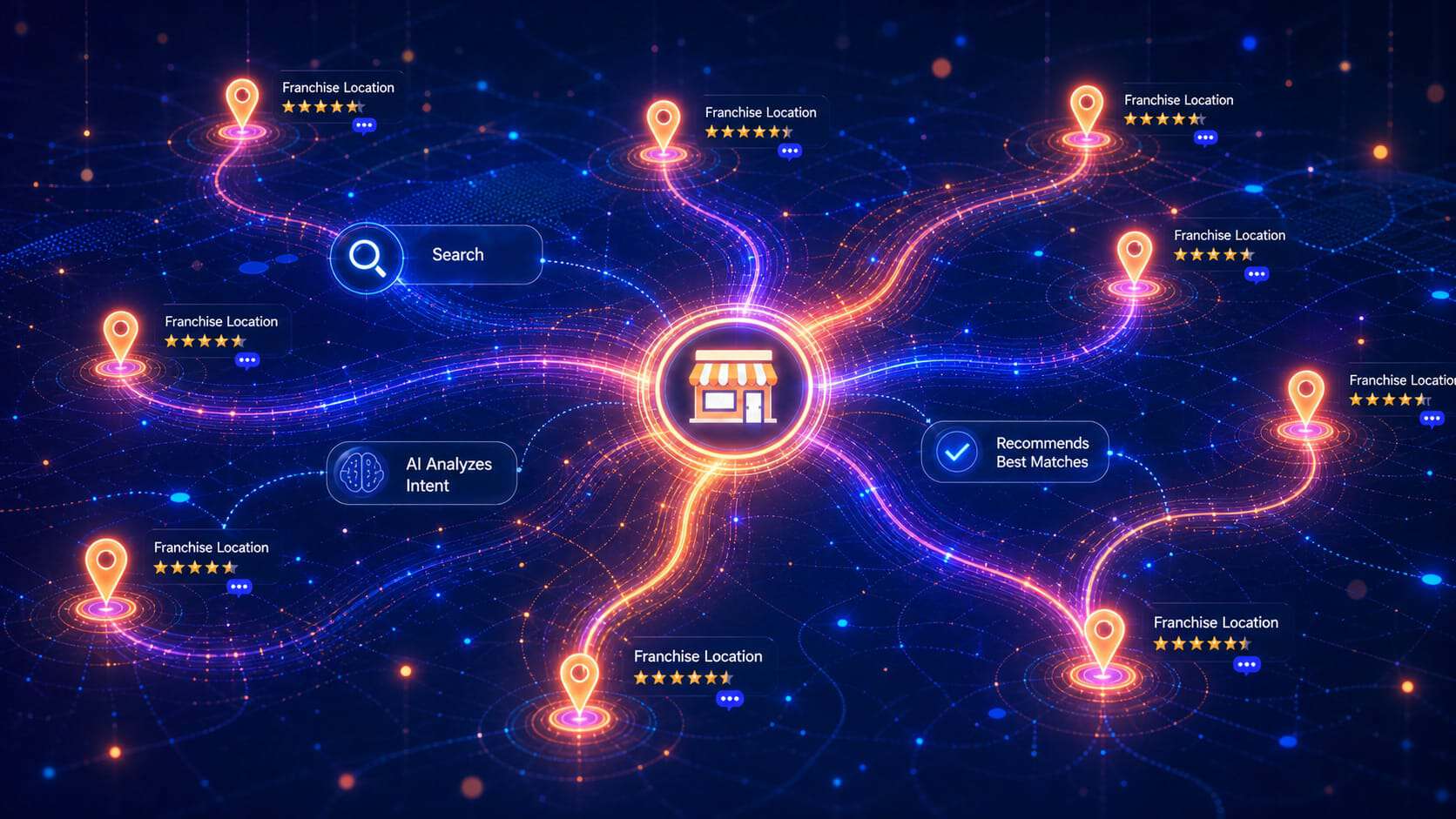
In May 2026, Google announced changes to its AI search functionality that are expected to profoundly and quickly reshape online visibility. The implications for franchise networks are especially significant. Learn about the changes and what steps franchises should be immediately taking.
Google Search Is Undergoing Its Biggest Transformation in Decades
Google is fundamentally reshaping how people discover information online.
At its Google I/O conference on May 19, 2026, Google unveiled its new “intelligent search box,” which is designed for longer, conversational questions and capable of processing text, images, files, videos, screenshots, and even Chrome tabs as inputs.
Search Engine Land described the rollout as Google’s biggest search-box transformation in 25 years, powered by Gemini 3.5 Flash. At the center of this shift is Google AI Mode, which is a search experience that behaves more like an assistant than a search engine.
Instead of simply returning a list of websites the user can click on to learn more, Google will:
- summarize answers directly in search
- compare businesses automatically
- generate recommendations
- create interactive visuals and dashboards
- handle follow-up questions conversationally
- monitor topics on behalf of users through AI “agents”

What Google’s New AI Search Experience Actually Looks Like
The new intelligent search box dynamically expands to support longer, more conversational questions, while a new AI-powered query suggestion system helps users craft more nuanced and complex searches beyond simple autocomplete. Google is also enabling follow-up questions directly within AI Overviews, creating a more interactive and conversational experience.
Powered by a combination of Gemini and Google Antigravity, the company’s agentic development platform, search results are increasingly expected to resemble interactive web experiences with dynamic layouts and interactive visuals.
Google’s AI systems will synthesize reviews, business listings, menus, hours, location data, photos, social proof, and third-party sources into a single recommendation experience.
Users will increasingly receive:
- AI-generated summaries
- side-by-side business comparisons
- personalized recommendations
- interactive planning tools
- dynamic maps and dashboards
- suggested next questions
Agentic AI Is Going Mainstream
Google is also launching easy-to-use “AI agents,” which are background assistants that continuously monitor the web and notify users when relevant information changes.
For example, a consumer could ask Google to:
- monitor pricing changes
- watch for local promotions
- compare competitors automatically
- track new business openings
- alert them when a service matches specific criteria
This means that instead of simply answering questions, AI systems will increasingly monitor information, compare options, make recommendations, and more.
For example, instead of searching:
“What are the best home service franchises?”
A user may ask:
“Monitor the top-rated home service franchises in my area and notify me when one launches a promotion or opens nearby.”
Google’s AI systems will then continuously evaluate:
- reviews
- reputation trends
- promotions
- news coverage
- local activity
- consumer sentiment
Google is also expanding its agentic AI capabilities within search to support a broader range of real-world tasks, including local experiences and service bookings. Users will be able to provide detailed criteria, such as finding a family-friendly restaurant for a group of eight with patio seating and vegetarian options, and Google will surface real-time pricing, availability, and direct booking options from participating providers.
Why This Matters for Franchise Organizations
This shift will significantly reshape how franchise brands are discovered, evaluated, and recommended online, both from a consumer perspective and by prospective franchisees.
Historically, franchise companies have focused heavily on SEO rankings for keywords like:
- “best pizza near me”
- “home services near me”
- “tutoring for my child”
- “fitness franchise opportunities”
This type of ranking is still important in the short-term, but the bigger challenge going forward is whether Google’s AI systems:
- understand your brand
- trust your information
- cite your content
- recommend your locations
- compare you favorably against competitors
Website Traffic Is Expected to Decline
Franchise organizations should expect organic website traffic patterns to change significantly as AI search adoption increases. Because Google answers questions directly inside AI Mode, fewer users will click through to websites.
Instead, users will make decisions based entirely on:
- AI summaries
- Google Business Profile data
- reviews
- third-party mentions
- AI-generated comparisons
This means franchise brands can no longer measure success solely through rankings and clicks.
Visibility inside AI-generated answers is quickly becoming the most important measure of success.
Local Franchise Data Will Become Critically Important
Google’s AI systems increasingly rely on structured local business information. If your franchise locations have inconsistent hours, outdated service descriptions, weak reviews, missing photos, or inaccurate business data, AI systems may:
- exclude locations from recommendations
- recommend competitors instead
- present inaccurate information
For franchise systems with hundreds or thousands of locations, this becomes a major operational challenge. This is also increasing the importance of the technology infrastructure franchise organizations use to coordinate marketing across locations. Franchise digital marketing platforms are increasingly responsible for helping brands manage local execution, content, advertising, data, reporting, and other marketing activities at scale.
Franchise Development Search Is Expected to Change Dramatically
Prospective franchisees are increasingly using AI-driven search for research and comparison. Instead of browsing dozens of franchise websites, candidates may ask:
“What are the best low-investment service franchises with strong support systems and recurring revenue?”
Google’s AI systems synthesize information from across the internet, including:
- franchise directories
- reviews
- PR coverage
- investment data
- third-party content
- franchisee testimonials
- brand authority signals
In this environment, franchise brands with stronger digital authority and clearer positioning will gain a substantial advantage.
Reputation Signals Will Matter More Than Ever
AI systems rely heavily on corroboration across multiple sources. This means that search visibility will be impacted by:
- reviews
- PR mentions
- news coverage
- awards
- franchise directory listings
- social engagement
- community reputation
A franchise company with weak reputation signals or inconsistent messaging will likely struggle to gain visibility inside AI-generated answers.

What Franchise Companies Should Be Doing Right Now
Franchise organizations should be actively taking steps to increase visibility in AI search.
(1) Review Your AI Brand Visibility and Sentiment
Ideally, franchise companies should work with their SEO teams to assess brand visibility and sentiment in AI searches using dedicated evaluation tools. This removes personalization and other factors which can bias the search results.
However, if you do not have access to these tools, as a bare minimum, franchise companies should manually conduct incognito AI searches to see how Google describes and recommends your brand.
Search prompts could include:
- “Best [industry] franchise near me”
- “Top franchise opportunities in [category]”
- “Best-rated [service] companies nearby”
- “Compare [your brand] vs competitors””
- “Most trusted [industry] brands”
Document:
- whether your brand appears
- which competitors appear
- what information Google uses
- any inaccuracies or outdated data
- whether locations are represented properly
- which third-party sources are being cited
- if the AI is positioning your brand in a positive way
This should become a recurring monthly exercise.
(2) Strengthen Location Pages on Your Website
Your website remains your most manageable ranking influencer. Unfortunately, many franchise location pages are still not AI-ready.
Every location should have a microsite or webpage nested under your main domain that includes:
- unique local content
- clear service descriptions
- accurate business hours
- FAQ sections
- local reviews and testimonials
- location-specific photos
- structured schema markup
- service-area details
- staff or ownership information where appropriate
- community forums
Thin, duplicated location pages perform poorly in AI-driven search.
(3) Invest in Reviews and Reputation Management
Reviews are becoming foundational AI trust signals. Franchise systems should implement structured review-generation strategies across all locations.
Focus on:
- increasing review volume
- improving review freshness
- responding consistently
- encouraging keyword-rich customer feedback
- addressing negative reviews quickly
AI systems increasingly evaluate sentiment, consistency, and recency. Brands with stronger review ecosystems will gain disproportionate visibility advantages.
(4) Create Conversational, Question-Based Content
AI search is driven by natural-language questions. Franchise brands should build content that directly answers real customer and prospective franchisee questions, such as:
- “How much does it cost to open a tutoring franchise?”
- “What should I look for in a home services company?”
- “How often should I schedule professional cleaning services?”
- “Is [brand] open on weekends?”
Avoid using overly complex language and long paragraphs. Short, direct answers written at a 9th grade level are ideal.
(5) Expand PR and Third-Party Authority Signals
AI systems trust brands that are consistently referenced across credible external sources. Franchise organizations should actively pursue:
- franchise publication coverage
- industry awards
- podcast appearances
- association partnerships
- news mentions
- expert commentary
- community involvement
- locally focused forums
These authority signals influence AI recommendation systems for both consumer and prospective franchisee searches.
(6) Improve Structured Data and Technical SEO
Technical SEO is becoming critically important in the AI era. Franchise companies should ensure:
- Schema markup is implemented properly
- location data is standardized
- business information is synced across platforms
- sites load quickly
- mobile experiences are strong
- content is crawlable and organized clearly
- duplicate content issues are minimized
AI systems rely heavily on structured, trustworthy, machine-readable information.
(7) Rethink KPIs Beyond Website Traffic
As search shifts increasing towards AI results, we as marketers need to re-assess what our measures of success are. Franchise marketers should begin tracking:
- AI visibility
- citation frequency
- brand mention prevalence
- local recommendation appearance
- share of AI-generated answers
- reputation sentiment trends
- competitive AI positioning
The future of search performance is increasingly about visibility and influence inside AI systems.
Summary
AI search is expected to profoundly and quickly reshape online visibility. For franchise organizations, the implications are especially significant because success depends heavily on:
- multi-location visibility
- local reputation
- consistent data
- brand trust
- third-party validation
- structured content at scale
The franchise brands that invest now in stronger digital authority, accurate local data, and AI-ready content will be best positioned to remain visible, trusted, and competitive as search continues to evolve.
Sources


